Dr Jeanine Griffin, lead curator for Wild Eye, has written a paper on how art can bring attention and understanding to seaweed for the journal Applied Phycology.
Overview
An exploration of the role of art in developing awareness, engagement and action for climate and conservation in relation to seaweed, by means of a case study of Sea Oak – a sculpture by artist Paul Morrison at Scarborough Harbour. The sculpture is part of Wild Eye, an art and nature programme celebrating North Yorkshire’s incredible wildlife and coastal environment.
The project is an innovative collaboration between Yorkshire Wildlife Trust and art/science organization Invisible Dust with North Yorkshire Council. The Wild Eye project, supported by the North Yorkshire Council, aims to deliver long‐term sustainable economic growth for Scarborough’s nature-culture tourism market and to support public reconnection with the environment.
Wild Eye hopes to foster a greater understanding of the amazing wildlife found across the North Yorkshire Coast through artworks and events, raising awareness of issues around nature, biodiversity and climate change. Measurement against these aims, like the project, is still in progress, but this case study aligns with research which finds that involvement with art has been shown to increase mobilization for climate and conservation action through raising awareness and engagement.
Highlights of the paper
– The creation of a sculpture, specifically of a seaweed, was inspired by the importance seaweeds play in ocean health.
– The sculpture name, Sea Oak, is a way of making a direct link between marine and terrestrial forests.
– The sculpture functions both as a piece of art and as a focus for wider public engagement on environmental issues.

The sculpture
On 16 March 2024, exactly 225 years after the birth of seaweed cyanotype pioneer Anna Atkins (author of Photographs of British Algae: Cyanotype Impressions, 1843) a sculpture was launched in Scarborough, North Yorkshire, UK. Three metres high but only a few centimetres thick, ‘Sea Oak’ has the form of a seaweed specimen rendered in cyanotype, like Atkins’ or pressed as is routinely employed for their preservation in an archive, such as the herbarium maintained at the Natural History Museum, UK. Fabricated in water jet cut, marine grade stainless steel polished to a mirrored finish, the sculpture is situated at the vanishing point of a sea wall walkway, a stone’s throw away from the North Sea. In this prominent position in Scarborough Harbour, the artwork can reflect the ever-changing conditions of the sea and sky, as well as the viewer and perhaps also cause us to reflect upon our inter-connectedness with nature.
-
 Sea Oak by Paul Morrison at Scarborough Harbour© Richard Ponter
 -
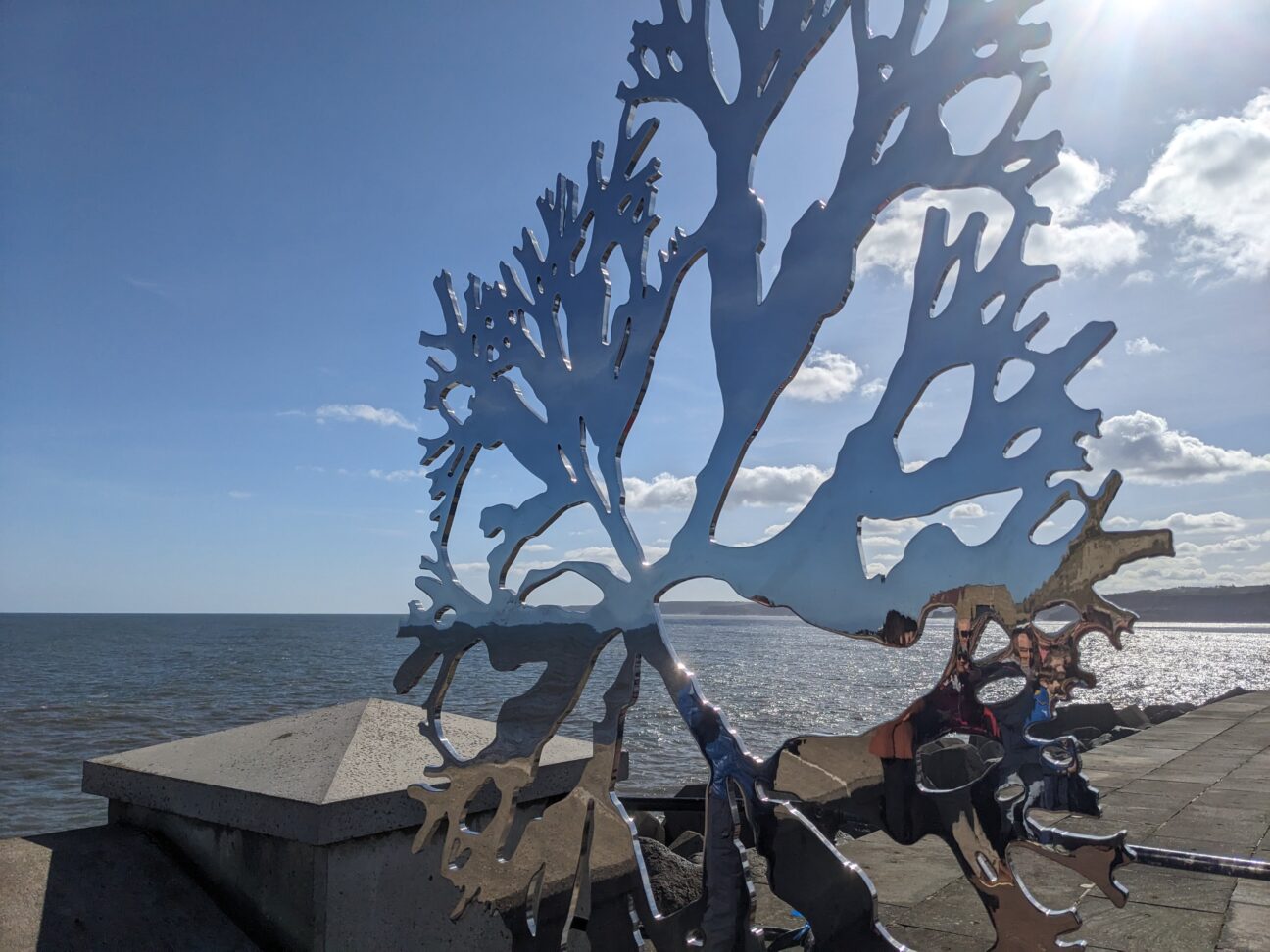 Sea Oak sculpture by Paul Morrison© Richard Ponter
The artist
The sculpture has been created by internationally renowned, Yorkshire-based artist Paul Morrison, whose work often employs modified archival imagery of botanical photography and illustrations. The flatness of the sculpture, the curious combination of 3D and 2D is because Morrison takes much of his inspiration from such botanical archives and in this case the work of Anna Atkins and the Seaweed Collections online archive.
As well as sculptures, Morrison creates large-scale monochrome wall paintings using plant imagery, often manipulating scale so that, for example, a humble dandelion is enlarged to a dominant position in an imaginary landscape. Large-scale sculptures depicting dandelion plants also render what is usually considered an unwanted weed on a monumental scale, valorizing what is often overlooked.
It is therefore appropriate that Morrison was selected by Invisible Dust and Yorkshire Wildlife Trust, alongside a local advisory group, for this piece referencing seaweed. It is a similarly prolific but often undervalued botanical species, something that is so common in coastal areas that it goes almost unnoticed. Because of the reflective nature of the sculpture and changing light conditions it sometimes mirrors its surroundings so much that it almost disappears. In this it is somewhat like seaweed, which is inconspicuous despite its prominent presence on the seashore. It is particularly pertinent for Scarborough to host a sculpture depicting seaweed, since the void left by the fishing industry’s decline has been partly filled by seaweed farm development and research (Sea Grown).
-
 Bladderwrack seaweed© Christopher Bill via Unsplash
Seaweed and ocean health
The sculpture depicts Fucus vesiculosus, or bladderwrack, and is inspired by the positive role that seaweed plays in contributing to the health of the ocean. This representation of a seaweed has the potential to raise awareness among the wider public of seaweed’s importance in sequestering carbon, oxygenating seawater, absorbing excess nitrogen, providing an important habitat for marine life and protecting coastlines (Morris et al., reference 8) as well as its longstanding entanglement with human life, from nutrition and therapeutic uses, to bioplastics and toothpaste (Farghali et al., reference 2). Indeed, the artist noted: “I knew about the medicinal properties of seaweed, and its importance as a habitat for marine life. What I hadn’t realized initially, is just how effective seaweed is as a store for carbon, and that it absorbs CO2 more efficiently than trees.”
Making the link between terrestrial and marine forests
The sculpture’s title, ‘Sea Oak’, makes the explicit link between our forests on the land and those under the sea. Yet whilst there are public pressure groups to protect trees and woodland, there does not seem to be a similar groundswell of concern for the conservation of seaweed beyond the scientific community. With warming waters and worsening seawater quality meaning that by 2100 we will have lost as much as 70% of our kelp forests under certain climate scenarios (IPCC, reference 5), there is an urgent need to bring this issue to wider attention. The sculpture, therefore, functions both as a striking work of art and also as a timely reminder of the interconnectedness of planetary health, both above and below the waterline.
Celebrating nature and fostering engagement
The sculpture was commissioned as part of Wild Eye, the art and nature programme celebrating North Yorkshire’s incredible wildlife and coastal environment. The project is an innovative collaboration between Yorkshire Wildlife Trust and art/science organization Invisible Dust with North Yorkshire Council. The council administered funding from the Department for Levelling Up and Housing and Communities’ Towns Fund to support the Wild Eye project’s ambition to increase public awareness on the health of the environment and concurrently help to deliver long-term sustainable development of Scarborough’s culture and nature tourism market (Figure 4). Wild Eye aims to foster a greater understanding of the amazing wildlife found across the North Yorkshire Coast through artworks and events, raising awareness of issues around nature, biodiversity and climate change.
Outreach through associated community engagement and media
Sea Oak by Paul Morrison connects with existing sculptures by Ryan Gander and Juneau Projects at Scarborough Castle and Whitby Harbour, respectively. There are further artworks planned from Shezad Dawood & Daisy Hildyard, Jeremy Deller and Emma Smith to complete the art trail by mid-2025. Only then will it be possible to fully measure the impact the project has had towards its objectives, however more than 12 500 people have attended Wild Eye events and activities since 2021, with this number exclusive of those who have visited the outdoor artworks. Of local people surveyed, 86% felt that initiatives, such as Wild Eye, helped increase awareness of climate change and marine plastic pollution and that 95% welcomed a project linked to seaweed.
The programme has involved local communities in focused engagement work linked to each of the outdoor artworks. Linked to Ryan Gander’s sculpture, in 2021, the project Sea Songs, saw Scarborough Sixth Formers work with acoustic artist Rob Mackay to create field sound recordings of marine mammals and their underwater environment, which were turned into an audio walk for Scarborough and Whitby, available online.
Also, in 2021, a series of podcasts or ‘audio postcards’ were produced for Wild Eye by sound artist Lucia Scazzocchio at Social Broadcasts, who spoke to North Yorkshire residents, scientists, artists and conservationists about their views on the marine environment, climate and the future. These were also broadcast on local and national radio, reaching a wide audience. (The overall audience reach of media coverage of the Wild Eye project in its first year was estimated at 3.3 million views.)
The development of the Sea Oak sculpture has similarly run in tandem with community engagement, including Big Seaweed Search events and a series of free creative workshops for local groups, led by Scarborough-based artist Jacqui Barrowcliffe. Participants were taught how to develop seaweed cyanotypes (Figure 5a,b), also known as sun prints, by combining seaweed and plastic litter collected from Scarborough beaches. These techniques were taught whilst discussing the importance of seaweed for carbon capture and biodiversity, embedding awareness-raising and conservation messages within creative practice.
-
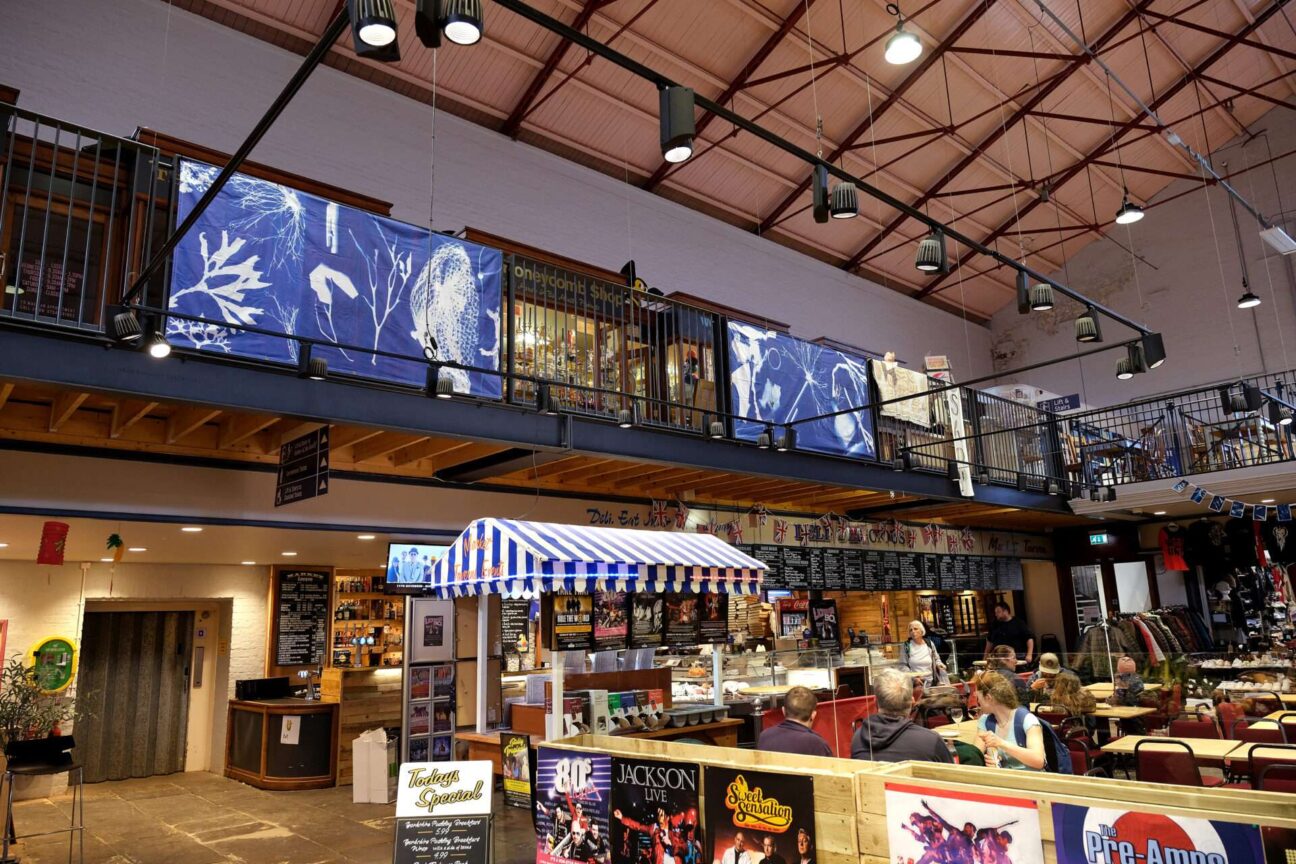 After Anna: Blueprint Impressions from Today’s Seas. Cyanotype Display at Scarborough’s Market Hall© Richard Ponter
“I enjoyed learning a new technique and art style, as well as the fact that the art we made has a deeper message” – A Scarborough Sixth form participant said of the workshop
Groups that took part in the workshops included Scarborough Sixth Form, Scarborough Disability Action Group, Gallows Close Community Centre, Barrowcliff Primary School, and members of the public.
The inspiration of Anna Atkins
This project culminated in After Anna: Blueprint Impressions from Today’s Seas – an exhibition of seaweed sun prints made by the Scarborough community. These were presented in an empty shop window on a main thoroughfare and as large-scale banners at Scarborough’s Market Hall. The project was inspired by the pioneering work of Anna Atkins, an English botanist and artist, considered the first person to have published a book illustrated with photographic images and by some as the first woman to create a photograph. This project celebrated Atkins’ work whilst reflecting on how our seas have changed in the 180 years since her book was published, with several species of seaweed now extinct, rapidly warming seas and an ever-increasing amount of plastic litter invading the marine ecosystem. This work, therefore, celebrated pioneering women in science and employed methods from that time, but applied them with a modern-day perspective to raise awareness to the challenges facing our oceans.
-
 Artist Jacqui Barrowcliffe in front of community-made cyanotypes, displayed in a shop window in Scarborough.© Richard Ponter
 -
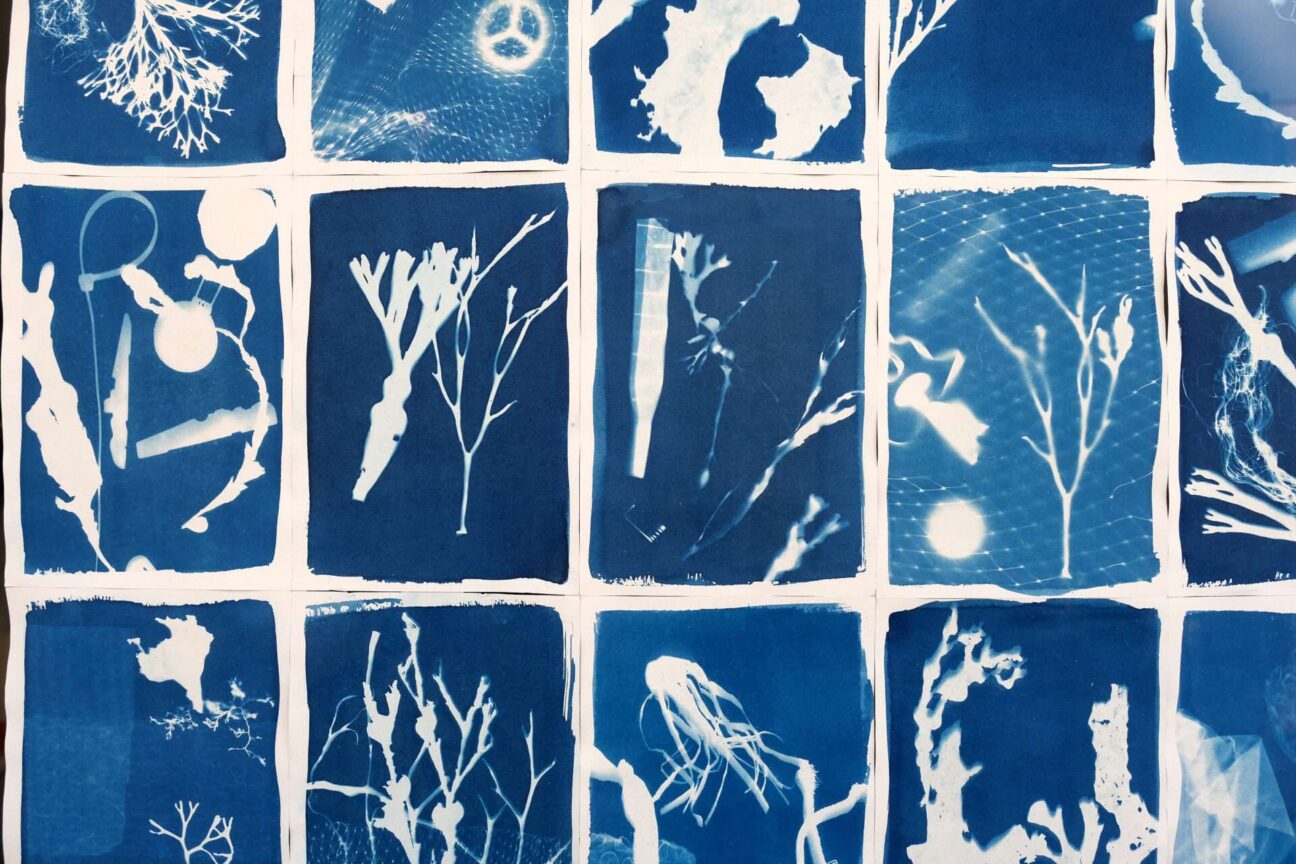 Community made cyanotypes displayed in an empty shop window on Newborough, Scarborough© Richard Ponter
This was a direct way to engage people in conversations about the ecological significance of seaweed whilst undertaking creative activity. Such involvement in art has been shown to increase ‘climate hope and mobilisation for climate action through providing a medium of expression, processing, and engagement’ (Hutchin, reference 4, see also Bentz, reference 1). Engendering this hope and mobilization is vital and is a key aim of the Wild Eye project.
In addition to hands-on activity with the local community, visitors to the sculpture over the coming years can also access a 6-minute audio file about the project, which weaves together voices from the worlds of art, nature and marine biology, talking about the artwork and its context. Research suggests that receiving information about artworks in a dynamic way, via audio or visual media, rather than text-based information, enables a more effective engagement (Lynch, reference 7). This is an approach Wild Eye continues to take to artwork interpretation. Visitors can scan the QR code on the information panel near the sculpture and then take a moment to listen to the lyrical composition of field recordings and conversation about seaweed and art created by Social Broadcasts.
Wild Eye, like much of Invisible Dust’s broader practice, draws on research which suggests that art and creative activity can engage people more significantly with science, climate change and conservation than pure information can, enabling greater reflection and emotional connection (Gorsegner, reference 3; Jigssa, reference 6). Artworks like these can be catalysts for thinking; not didactic but creating open questions, leaving space for the viewer to interact with them and form their own opinion. As Paul Morrison says: ‘The piece will inevitably mean different things to each viewer, depending on the person’s experiences, memories and associations. But I’d be very pleased if one of the things that it does is to provide an opportunity for people to pause and consider our interdependence with nature.’
Dr Jeanine Griffin is lead curator for the Wild Eye project and author of this paper for Applied Phycology Volume 5, 2024.
Acknowledgements
Thanks to artists Paul Morrison, Jacqui Barrowcliffe, Rob Mackay and Lucia Scazzocchio and all staff on the Wild Eye project, in particular Caroline Hill, Yorkshire Wildlife Trust and Alice Sharp, Artistic Director, Invisible Dust.
References
1. Bentz, J. (2020). Learning about climate change in, with and through art. Climatic Change, 162(3), 1595–1612. View
2. Farghali, M., Mohamed, I. M. A., Osman, A. I., & Rooney, D. W. (2023). Seaweed for climate mitigation, wastewater treatment, bioenergy, bioplastic, biochar, food, pharmaceuticals, and cosmetics: A review. Environmental Chemistry Letters, 21(1), 97‒152. View
3. Gorsegner, A. (2016). The role of art in the global climate change movement. Masters of Science, Drexel University. View
4. Hutchin, F. (2024). Exploring the impact of arts engagement on climate anxiety and to mobilise climate action in young people. View
5. IPCC. (2023). Sections. In: Climate Change 2023: Synthesis Report, H. Lee, & J. Romero (Eds.), Contribution of working groups I, II and III to the sixth assessment report of the intergovernmental panel on climate change [core writing team (p. 35‒115). IPCC. View
6. Jigssa, E. A. (2023). How Art can Amplify Efforts to Address Climate Change, with contributions from the IGAD Climate Change Technical Working Group. View
7. Lynch, H. (2006). Mapping interpretation practices in contemporary art. Retrieved March 15, 2024, from: View
8. Morris, R. L., Graham, T. D. J., Kelvin, J., Ghisalberti, M., & Swearer, S. E. (2020). Kelp beds as coastal protection: Wave attenuation of Ecklonia radiata in a shallow coastal bay. Annals of Botany, 125(2), 235‒246. View


