The Wild Eye programme has been developing since 2020 to include a modernist eco-concrete sculpture in a heritage setting; a series of community co-produced seating structures reflecting the wildlife of the Esk estuary in Whitby; a sculpture depicting bladderwrack seaweed as if a pressed archival botanical specimen had been hugely enlarged; hybrid human-marine creatures existing on the cusp of reality with an accompanying backstory drawing on Scarborough’s colonial past and imagined future; a series of bio-adaptive seating sculptures holding 35 million year old sea fossils along an ex-railway line that once linked Scarborough and Whitby, and a contemporary relic – a Roman Mosaic c. 2025 – depicting the sea life off the coast of Scarborough.
As varied as they are, a common thread between these projects is a sense of our position entangled within nature on a scale of deep time and also a sense of appreciation for the overlooked. There is spectacular wildlife and green and blue spaces along this coastline – charismatic sea creatures and amazing natural heritage, but the artworks also invite us to look afresh at the remarkable in the everyday.
Scarborough has a Roman past which is very apparent today – there is a Roman signal station on the castle headland above Marine Drive and school children do an archaeological ‘big dig’ each year. Viewing Roman remains, particularly mosaics, can give us an unnerving sense of deep time, with evidence of lives like ours and wildlife we recognise existing millennia ago. If we project forward a similar timespan, we see a very uncertain future for the natural world of which we are part. Roman Mosaic c. 2025, conceived by Jeremy Deller and designed and created with Coralie Turpin, contains a central conundrum which is encapsulated in the title: it is a piece of contemporary archaeology made to look like an authentic relic from the past, that invites us to think about the future.
Meanwhile, Emma Smith’s new works, co-designed with local communities and crafted by hand from local stone rich with ancient sea fossils, also captures this sense of our relationship with the natural world over long periods of time and the sense of it preceding us. Her sculptural pieces along this important green corridor offer places of pause and interaction between species, increasing kinship with nature. Research tells us this time spent in nature, as well as benefitting our wellbeing, will also increase our likelihood to work for nature justice.
Shezad Dawood and Daisy Hildyard’s augmented reality piece and world building short fiction also takes us across time from Scarborough’s prehistory to its speculative future, via its imperial heyday, connecting aeons in succinct narrative and imaginative leaps towards a hybrid future impacted by the climate crisis, when sea levels have submerged Scarborough and new species have co-evolved.
Ryan Gander’s work also draws us into future thinking by using a modernist piece of civic engineering prevalent in the artist childhood and still very present along Scarborough sea front today – concrete shapes made to prevent coastal erosion. By amending the shape so it is only completed by snowfall, he draws our attention to the increasing rarity of snow in our future due to global heating. He asks us to consider ‘para-possible futures’ – whether we allow particular climate trajectories to occur will determine whether we have snow in our future and whether the sculpture is ever complete.
And the artworks also draw attention sometimes to the overlooked in nature. This could be the invisible microbiome from soil and plants – the ‘Old Friends’ which support our health (in Emma Smith’s work) or the species which become unremarkable by their ubiquity – but are nonetheless important for our ecosystems. Paul Morrison’s sculpture valorises the seaweed which is ever present in Scarborough. It takes the place of the lowly dandelion that often inhabits his pieces – the weed which is manipulated to enormous scale, Here seaweed, which is so important for marine health, coastal welfare and carbon capture, is given this elevated status.
As a series, the cumulative effect of the artworks aims to undermine human exceptionalism and highlight our place within, not outwith, nature: entangled and co-dependent.
The Oxford English Dictionary has updated its definition of the word “nature” to include humans in a wider sense, but the primary definition still excludes humans. The ‘We Are Nature’ campaign presented the OED with evidence of historical uses of the word “nature” that included humans and is fighting for this evident truth to be acknowledged in this repository of meaning.
Wild Eye invites us to appreciate our place within nature, not without it, and to learn to understand it better. This is echoed in the title of Juneau Projects’ sculptural seating created with local people in Whitby harbour – ‘There is another Alphabet’ . The full quote from which this is taken is – “There is another alphabet, whispering from every leaf, singing from every river, shimmering from every sky.” by Dejan Stojanovic in a poem titled ‘Forgotten Home’. This also recalls The Smith’s lyric “Nature is a language, can’t you read?”
We hope the art of Wild Eye helps us learn to read this language better, to appreciate and interpret the lexicon of nature and create a continuity of care between the nature of the past and that of the future (us included).
Dr Jeanine Griffin.
Thanks:
The ecosystem of Wild Eye has involved a process of learning from and with nature alongside artists, curators, conservationists from Yorkshire Wildlife Trust and beyond, community organisations (in particular Coast and Vale Community Association, Gallows Close Centre, Sparks, Scarborough and Whitby Disability Action Groups and WetWheels), schools including Friarage, Barrowcliff, Gladstone Road and Northstead primary schools, citizen scientists such as the Scarborough and Whitby Naturalists and Scarborough Porpoise groups and scientists and specialists from marine biologists to archaeologists. Along with our community advisory group, we gratefully thank them all.
-
 Coralie Turpin, Jeremy Deller and curator Jeanine Griffin review the mosaic design© Jules Lister
 -
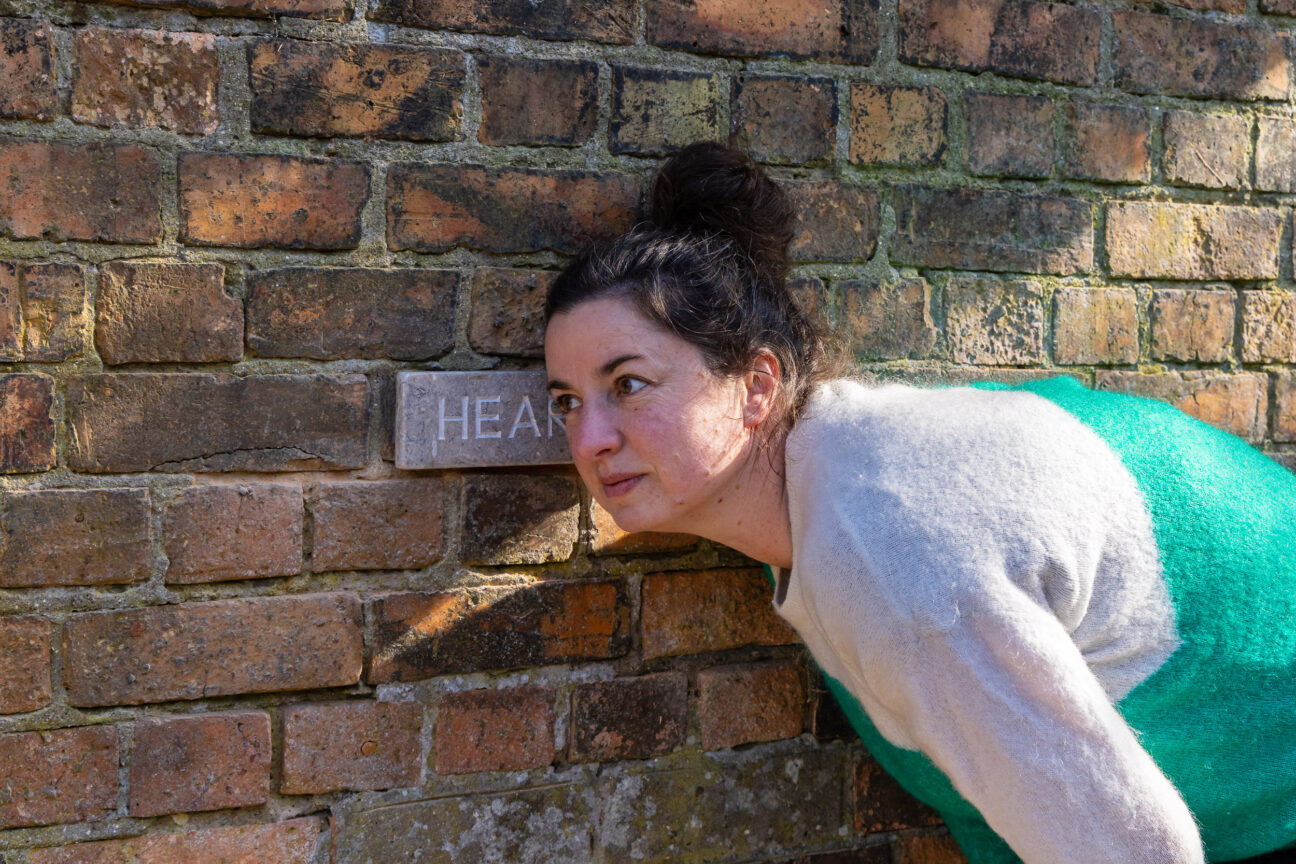 Artist Emma Smith's Old Friends series of sculptures along the Scarborough to Scalby section of the Cinder Track© Jules Lister
 -
 Daisy Hildyard and Shezad Dawood in Scarborough (2024)© Jules Lister
 -
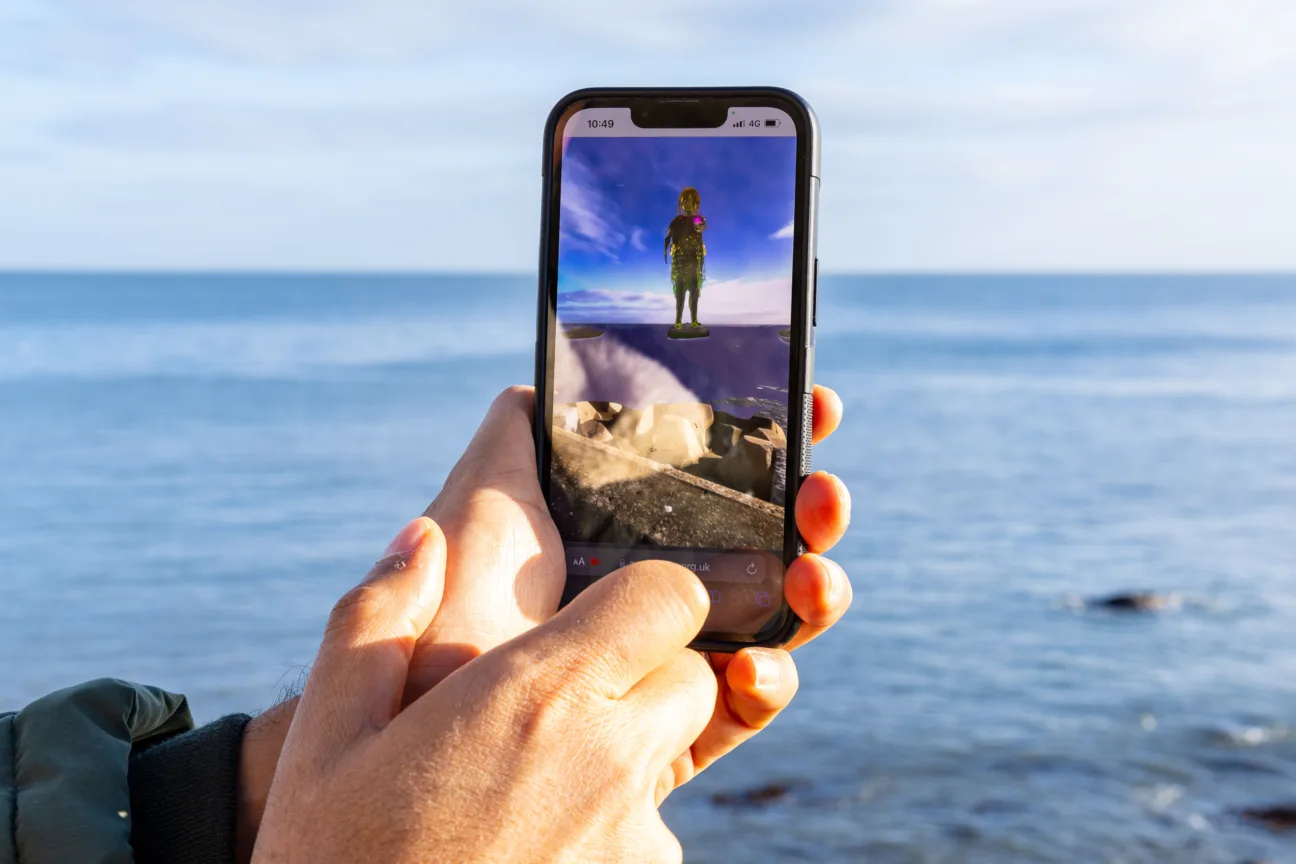 Ambiguous Machines, Shezad Dawood with Daisy Hildyard (2024). Commissioned by Wild Eye© Jules Lister
 -
 Sea Oak, Paul Morrison with Launch Crowd Richard Ponter for Invisible Dust 2024© Richard Ponter
 -
 We are only human (Incomplete sculpture for Scarborough to be finished by snow) Ryan Gander, 2022.© Jules Lister
 -
 Juneau Projects stand with their estuary nature bench in Whitby.© Richard Ponter and Juneau Projects


